
Poquoson, VA
Asian Tiger Mosquito Control in Poquoson
Aggressive daytime biter that breeds in containers, not marsh. Salt marsh mosquitoes at levels found almost nowhere else in the region, decay fungus and moisture damage in elevated framing, subterranean termites, and rodents moving in from the marsh edge.
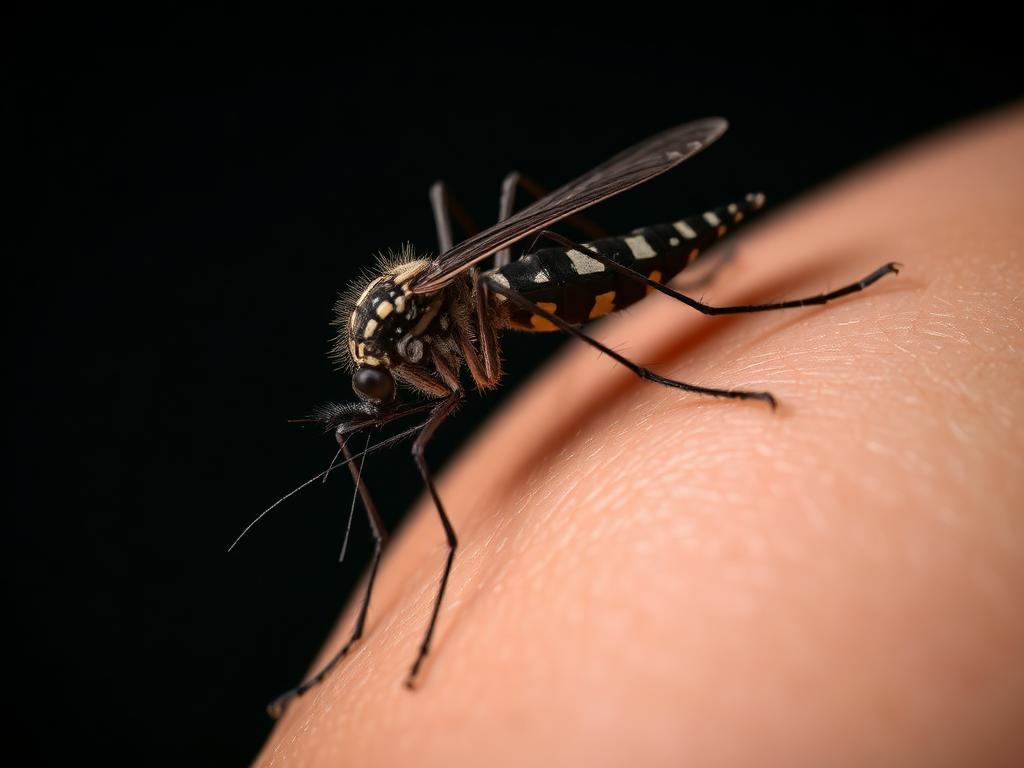
- Adult size
- 1/4"
- Color
- Black with a white dorsal stripe
- Group size
- Container breeder, hundreds
- Lifespan
- 2 – 8 weeks
Identifying it
Small black mosquito with a single white stripe down the back and banded legs. Bites during the day, close to the ground, and stays near where it hatched.
Why Poquoson sees this
It breeds in artificial containers holding tiny volumes of water — gutters, tarps, plant saucers, tires, toys. Every residential yard in the region supplies them.
Raised and pile-supported waterfront homes, mid-century ranches inland, and older watermen's cottages. Elevated construction is common because of repeated flooding.
Extensive salt marsh, minimal elevation, and repeated tidal inundation. Groundwater and salt exposure both attack framing and fasteners.
The Asian tiger mosquito is the reason a Chesapeake or Suffolk backyard becomes unusable at three in the afternoon, not just at dusk. Unlike the marsh species that drive whole-neighborhood swarms after a high tide, this one operates on a small radius, usually within a few hundred feet of wherever it hatched, and it hatches in whatever holds water in a yard: a clogged gutter, an upturned wheelbarrow, a tarp fold, a saucer under a potted plant. Its black-and-white banded legs and single white stripe down the thorax make it easy to identify once you know to look.
Activity begins as soon as daytime highs hold above the mid-60s, usually April, and peaks from June through September when Hampton Roads humidity and afternoon thunderstorms keep containers topped off continuously. Hurricane season adds a second, sharper pressure spike: a tropical system that dumps four to six inches of rain in a day fills every unattended container across Chesapeake and Virginia Beach simultaneously, and the resulting adult population surge shows up ten to fourteen days later almost like clockwork. Activity tapers with the first sustained cool nights in October, though a mild fall can push biting pressure into early November.
When asian tiger mosquito activity peaks
Biting is worst in the daytime from July through early September.
July — activity index 100 / 100 (annual peak)
Does yours match? Interactive ID checklist
0 of 4 traits matched
Tick everything you can actually see.
Signs of asian tiger mosquito activity
- Bites accumulate on ankles and lower legs during daytime yard activity, not just at dusk.
- Standing water is visible in gutters, tarps, tires, or plant saucers within the property line.
- Small dark mosquitoes with a single white racing stripe are seen resting on shaded foliage.
- Neighbors on the same block report similar daytime biting complaints in the same weeks.
- Larvae — thin wriggling segments — are visible when a flashlight is shined into any container holding water.
- Biting pressure increases sharply seven to ten days after a heavy rain or storm event.
Asian Tiger Mosquito threat profile
Structural risk
0/100
Damage to framing, floors and finishes
Health risk
75/100
Bites, stings, allergens and pathogens
Spread rate
70/100
How fast it multiplies once established
DIY difficulty
75/100
How reliably store products fail on it
Field notes: asian tiger mosquito you did not know
- Fact 01
It bites during the day, which is why dusk-only avoidance never works here.
- Fact 02
Eggs survive dry for months and hatch the moment a container refills.
- Fact 03
It rarely travels more than 200 yards, so the source is almost always in your yard.
How we remove it
Source reduction of standing water first, then larvicide in retained water and barrier treatment of shaded resting vegetation.
Routing City of Poquoson daily, including Messick Point, Bull Island, Odd Road, Poquoson Shores, Yorkshire Downs.
The Guardex asian tiger mosquito treatment plan
01 · Source inspection
A technician walks the entire property, not just the visible lawn, checking gutters, low spots, tarps, boats, and any container capable of holding water for several days. This step finds the actual production sites, which is the only way to get ahead of a container breeder.
02 · Source reduction and larviciding
Containers that can be dumped, drained, or removed are addressed on site. Anything that must stay in place, such as a decorative water feature or a French drain catch basin, receives a larvicide labeled for that use to stop development before adults emerge.
03 · Barrier treatment of resting harborage
Backpack application targets the undersides of shrubs, shaded foundation plantings, and fence lines where adults rest between blood meals during the day. This is where retail yard sprays typically fail because they only cover open turf.
04 · Scheduled retreatment
Because adults live only a few weeks and new containers refill constantly, service is repeated on a roughly three to four week cycle through the warm season rather than treated as a single visit.
Why store-bought products usually fail
Retail fogging products and mosquito yard sprays are formulated to knock down adults on contact, and a tiger mosquito population rebuilds from eggs and larvae within days regardless of how thorough that single application was. Homeowners also tend to miss less obvious containers — the fold in a pool cover, water trapped in a tarp grommet, a clogged downspout elbow — because a tiger mosquito only needs a few days and a few tablespoons of water to complete a generation. Backpack and truck-mounted equipment used by a licensed applicator reaches vertical shaded harborage that a hose-end sprayer cannot, and larvicide products available to the public are limited compared to the professional-use options labeled for standing water that cannot be eliminated.
Prevention checklist
- Empty, cover, or store anything that can collect rainwater: buckets, wheelbarrows, saucers, toys.
- Clean gutters at least twice a year so they drain fully instead of holding pooled water.
- Flip tarps and boat covers so they shed water instead of pooling in the folds.
- Change bird bath water every three to four days.
- Keep grass cut and shrubs thinned along fence lines to reduce daytime resting harborage.
- Check the yard within a week of any heavy rain or storm for new standing water.
Asian Tiger Mosquito questions we get asked
- Why am I getting bitten in broad daylight?
- Asian tiger mosquitoes are unusual for feeding aggressively during the day, especially in early morning and late afternoon, rather than only at dusk like many other species. If daytime bites are accumulating in your yard, this is almost always the species responsible.
- Does GUARDEX treat this in my specific neighborhood?
- Yes, this is one of the most common service calls across Virginia Beach, Chesapeake, Norfolk, Suffolk, and Newport News, since the species breeds in ordinary yard containers rather than requiring marsh or wetland proximity.
- How long until I notice fewer bites after treatment?
- Barrier and larvicide treatment typically reduces biting pressure within a few days as existing adults die off and new larvae are stopped before emerging, though full control depends on eliminating breeding containers homeowners control themselves.
- How often does the yard need to be treated?
- Most properties are treated on a three to four week cycle through the warm season, since adult mosquitoes live only a few weeks and new rain events continually create fresh breeding sites.
- Can one property really cause a mosquito problem for the whole block?
- Yes. Because adults typically stay within a few hundred feet of where they hatched, one neglected container — a tarp, a tire, an uncleaned gutter — can seed biting pressure for several neighboring yards.
Other pests in Poquoson
- Eastern Subterranean Termite control in Poquoson
- Formosan Subterranean Termite control in Poquoson
- Powderpost Beetle control in Poquoson
- Carpenter Ant control in Poquoson
- Carpenter Bee control in Poquoson
- Wood-Decay Fungus control in Poquoson
- German Cockroach control in Poquoson
- American Cockroach control in Poquoson
- Oriental Cockroach control in Poquoson
- Odorous House Ant control in Poquoson
- Red Imported Fire Ant control in Poquoson
- Norway Rat control in Poquoson
- House Mouse control in Poquoson
- Squirrel control in Poquoson
- Camel Cricket control in Poquoson
- Springtail control in Poquoson
- Salt Marsh Mosquito control in Poquoson
- Blacklegged (Deer) Tick control in Poquoson
- Yellowjacket control in Poquoson
- Bed Bug control in Poquoson
- Brown Marmorated Stink Bug control in Poquoson
Asian Tiger Mosquito nearby in Virginia Peninsula
Asian Tiger Mosquito problem in Poquoson?
Tell us where you are finding them and how often. We will confirm the species and put a plan on the calendar.
Request an inspection