
Isle of Wight County, VA
Powderpost Beetle Control in Isle of Wight County
Fine flour-like frass under pinholes in crawl space framing and hardwood. Rodents around agricultural buildings, subterranean termites in older frame structures, fall invader migrations out of harvested fields, and moisture in unconditioned crawl spaces.
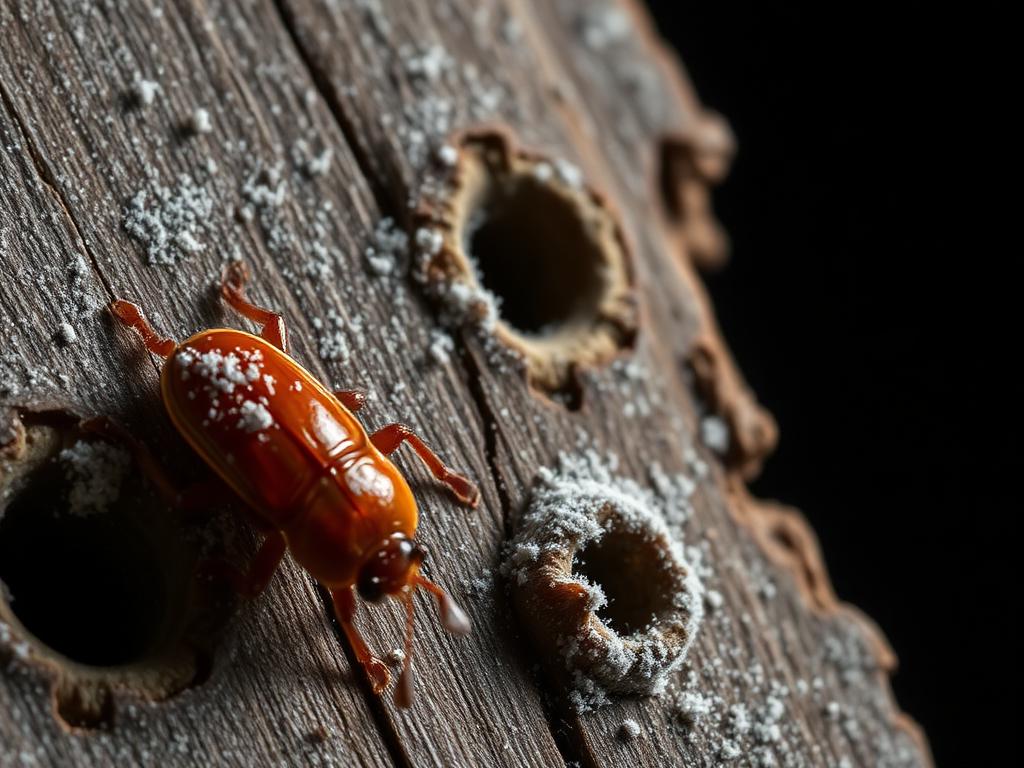
- Adult size
- 1/8" – 1/4"
- Color
- Reddish-brown to black
- Group size
- Generational reinfestation
- Lifespan
- 1 – 5 year life cycle
Identifying it
Round exit holes roughly the size of a pinhead with talcum-fine powder beneath. Anobiid activity concentrates in the joists and subfloor of damp crawl spaces; lyctid activity shows up in hardwood flooring, trim, and furniture.
Why Isle of Wight County sees this
Anobiid powderpost beetles need wood moisture above roughly fourteen percent. Older Hampton, Portsmouth, and Smithfield crawl spaces sit above that most of the year, and the region's historic stock has plenty of untreated original framing.
Farmhouses, manufactured housing, outbuildings, and newer subdivisions near Carrollton and Carollton-area commuter corridors.
Farmland, pine timber, and river frontage. Outbuildings, barns, and grain storage create harborage near living structures.
Powderpost beetles are named for the fine, flour-like frass they leave behind, and in Hampton Roads that frass shows up in two distinct places depending on which family is involved. Anobiid powderpost beetles infest damp structural framing, joists, subfloor, and sill plates in crawl spaces, while lyctid powderpost beetles attack drier hardwood such as flooring, trim, and furniture, often introduced already infested from a lumber yard or furniture supplier. Both leave round exit holes roughly the size of a pinhead, but the moisture story behind each is completely different.
Adult emergence and new egg-laying activity in this region peaks in late spring through summer as temperatures and ambient humidity climb, though because larvae develop inside the wood for extended periods, evidence of activity, fresh frass under an exit hole, can be noticed at any time of year. Crawl space moisture, and therefore anobiid activity specifically, tracks the region's rainfall pattern closely, with saturated soil after hurricane season and winter nor'easters keeping wood moisture elevated well past the storm itself. Homeowners in vented crawl spaces across Chesapeake and Virginia Beach often notice the fine sawdust piles most clearly during a spring cleaning or a pre-listing inspection, simply because that is when the space gets attention.
When powderpost beetle activity peaks
Adults emerge and fresh frass appears from April into August.
May — activity index 85 / 100 (annual peak)
Does yours match? Interactive ID checklist
0 of 4 traits matched
Tick everything you can actually see.
Signs of powderpost beetle activity
- Round exit holes about the size of a pinhead scattered across exposed framing or hardwood surfaces.
- Fine, talcum-powder-like frass accumulating directly beneath the holes on a joist, subfloor, or floorboard.
- Frass that feels powdery and flows easily, distinct from the coarser, insect-part-laden frass left by carpenter ants.
- Weakened or spongy-feeling wood in a crawl space that probes soft despite an intact-looking surface.
- Fresh, light-colored holes appearing in hardwood flooring or furniture within a year or two of installation.
- A persistent musty smell in the crawl space alongside visible beetle activity, indicating elevated wood moisture.
Powderpost Beetle threat profile
Structural risk
70/100
Damage to framing, floors and finishes
Health risk
5/100
Bites, stings, allergens and pathogens
Spread rate
45/100
How fast it multiplies once established
DIY difficulty
80/100
How reliably store products fail on it
Field notes: powderpost beetle you did not know
- Fact 01
The name comes from the frass: flour-fine powder that runs like talc between your fingers.
- Fact 02
Lyctids only attack hardwood pores, so oak floor joists and stair treads are the classic target.
- Fact 03
An infestation can ride into a house inside new flooring or a piece of furniture.
How we remove it
Borate treatment of accessible bare framing, replacement of heavily damaged members, and above all moisture reduction — the infestation cannot sustain itself in dry wood.
Routing Isle of Wight County daily, including Rushmere, Zuni, Walters, Battery Park, Benns Church.
The Guardex powderpost beetle treatment plan
01 · Inspection and moisture assessment
A technician inspects all accessible crawl space framing, subfloor, and any affected hardwood, taking moisture readings to confirm whether conditions currently support active anobiid breeding. This determines whether the issue is a lumber-only lyctid problem or an ongoing moisture-driven anobiid infestation.
02 · Borate treatment of bare framing
Accessible bare wood surfaces are treated with a borate solution that penetrates the wood and remains toxic to developing larvae long after application. This step targets both current larvae and future egg-laying by emerging adults.
03 · Replacement of structurally compromised members
Joists, sill plates, or subfloor sections with significant structural loss are replaced rather than treated, since borate does not restore lost wood strength. Replacement lumber is treated as part of the same visit to prevent immediate reinfestation.
04 · Moisture correction
Since anobiid activity cannot be sustained without elevated wood moisture, the underlying cause, poor crawl space ventilation, missing vapor barrier, or grading issues, is corrected as part of the treatment plan. This is the step that actually stops future infestation rather than just addressing the current one.
Why store-bought products usually fail
Retail borate sprays and wood treatment products are available over the counter, but they typically penetrate only the surface layer of the wood, while an established larval population is already tunneling well below that depth and remains completely unaffected. Homeowners also frequently misidentify which family of beetle they're dealing with, treating a moisture-driven anobiid infestation as if it were a one-time lyctid problem in furniture, which means the underlying crawl space moisture never gets addressed and new generations continue to emerge. Reaching every affected framing member in a low, tight crawl space with adequate product coverage is also physically difficult without professional equipment and access experience, and missed sections simply continue the infestation unaddressed.
Prevention checklist
- Keep crawl space wood moisture below fourteen percent through adequate ventilation, a vapor barrier, or encapsulation.
- Avoid storing unfinished or untreated lumber directly on a crawl space floor or against damp framing.
- Inspect new hardwood flooring or furniture purchases for existing exit holes before installation.
- Address any plumbing leaks or standing water in a crawl space promptly rather than letting wood stay saturated.
- Have crawl space framing inspected periodically, particularly in homes with original, untreated joists and subfloor.
- Consider borate pre-treatment on any exposed new framing installed during renovations in a historically damp crawl space.
Powderpost Beetle questions we get asked
- How much does it cost to treat powderpost beetles in a crawl space?
- Cost depends on the extent of affected framing and whether any joists or subfloor need full replacement rather than just borate treatment. A moisture-only issue treated early costs far less than a job requiring structural replacement, which is why early inspection matters.
- Are powderpost beetles common in my area, or is this rare?
- They are common in older crawl spaces across Hampton, Portsmouth, and Smithfield specifically because of chronic wood moisture from vented construction over a high water table. Newer, well-ventilated or encapsulated crawl spaces see far less activity.
- I found holes in new hardwood flooring, is that the same problem as in my crawl space?
- Not necessarily. Flooring and furniture holes are usually lyctid beetles that arrived already inside the wood, while crawl space holes in framing are more often moisture-driven anobiid activity. The two require different treatment approaches.
- How long does treatment take to actually stop the beetles?
- Borate treatment stops future larval development fairly quickly once applied, but existing larvae already deep in the wood may still emerge for a period afterward since borate doesn't reach every existing tunnel instantly. Moisture correction alongside treatment is what prevents a new generation from establishing.
- Will this show up on my home inspection report when I sell?
- Yes, powderpost beetle evidence is a standard finding category on the NPMA-33 wood-destroying insect report required at most regional closings. Addressing known activity before listing avoids a delay during the transaction.
Other pests in Isle of Wight County
- Eastern Subterranean Termite control in Isle of Wight County
- Formosan Subterranean Termite control in Isle of Wight County
- Carpenter Ant control in Isle of Wight County
- Carpenter Bee control in Isle of Wight County
- Wood-Decay Fungus control in Isle of Wight County
- German Cockroach control in Isle of Wight County
- American Cockroach control in Isle of Wight County
- Oriental Cockroach control in Isle of Wight County
- Odorous House Ant control in Isle of Wight County
- Red Imported Fire Ant control in Isle of Wight County
- Norway Rat control in Isle of Wight County
- House Mouse control in Isle of Wight County
- Squirrel control in Isle of Wight County
- Camel Cricket control in Isle of Wight County
- Springtail control in Isle of Wight County
- Asian Tiger Mosquito control in Isle of Wight County
- Salt Marsh Mosquito control in Isle of Wight County
- Blacklegged (Deer) Tick control in Isle of Wight County
- Yellowjacket control in Isle of Wight County
- Bed Bug control in Isle of Wight County
- Brown Marmorated Stink Bug control in Isle of Wight County
Powderpost Beetle nearby in Isle of Wight
Powderpost Beetle problem in Isle of Wight County?
Tell us where you are finding them and how often. We will confirm the species and put a plan on the calendar.
Request an inspection