
Portsmouth, VA
Carpenter Bee Control in Portsmouth
Perfectly round half-inch holes in fascia, decks, and railings. Subterranean termites in original sill plates and band joists, powderpost beetles in old-growth framing, structural decay fungus, rodents in the dense older blocks, and chronic crawl space humidity.
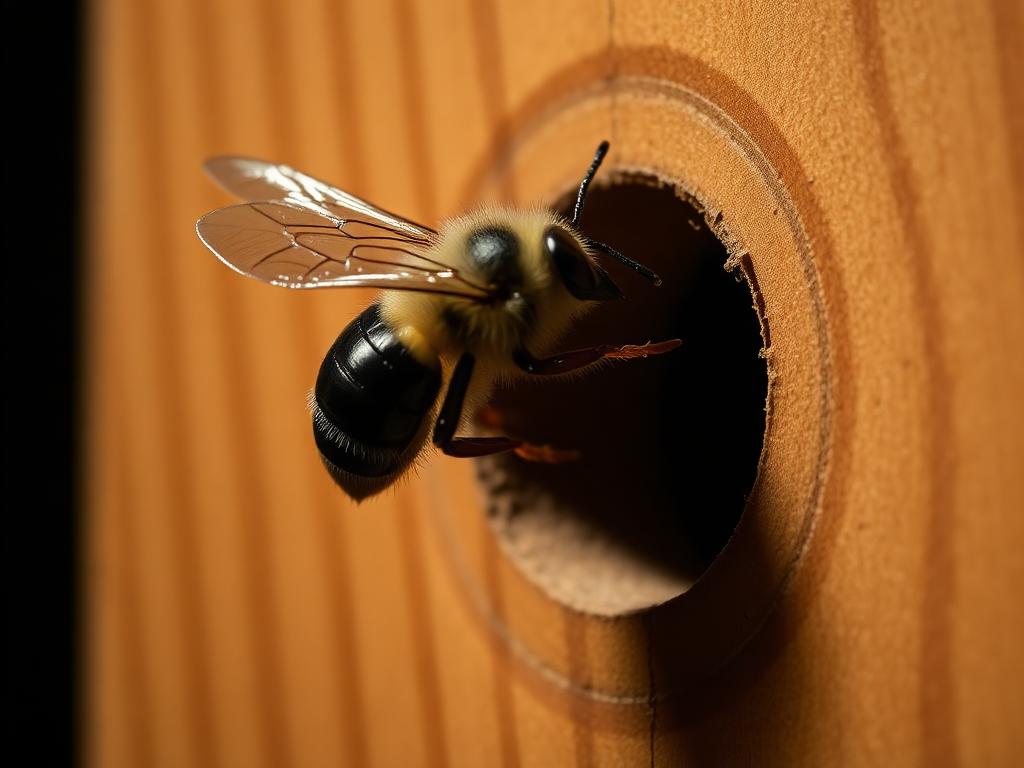
- Adult size
- 3/4" – 1"
- Color
- Shiny black abdomen, yellow thorax
- Group size
- Solitary, but sites are reused
- Lifespan
- About 1 year
Identifying it
Looks like a bumblebee with a shiny, hairless black abdomen. Males hover aggressively but cannot sting. Round entrance holes appear on unpainted or weathered softwood, usually on the underside of trim and rails.
Why Portsmouth sees this
Untreated and weathered exterior softwood is everywhere in this region, and the long warm season gives them an extended active period.
Historic frame and masonry structures in Olde Towne and Park View, mid-century frame in Churchland and Cradock. Crawl spaces are the norm and many are shallow, tight, and originally unlined.
Low-lying land on the Elizabeth River with a water table near grade and legacy drainage. Historic-district repair standards limit how aggressively exteriors can be altered.
Carpenter bees are easy to misidentify from a distance since they resemble bumblebees, but a closer look shows a shiny, hairless black abdomen rather than the fuzzy yellow-and-black pattern of a true bumblebee. The males are the ones homeowners usually notice first, hovering aggressively near a deck or eave and darting at anyone who walks past, but males have no stinger at all and the behavior is pure bluff. Females do the actual damage, boring perfectly round, half-inch entrance holes into unpainted or weathered softwood to create nesting galleries.
Activity begins as overwintering adults emerge in early spring, typically March into April in this region, and this is when the hovering, territorial males are most conspicuous around eaves, decks, and porch ceilings. Females are most actively excavating new or reused galleries through late spring into early summer, and the long regional warm season keeps this active period stretching further than it would farther north. New adults emerge from galleries in late summer to feed before returning to the same tunnels to overwinter, meaning some activity, though less conspicuous, can be observed into fall as well.
When carpenter bee activity peaks
Boring and hovering start with the first warm April days and run hard through June.
May — activity index 95 / 100 (annual peak)
Does yours match? Interactive ID checklist
0 of 4 traits matched
Tick everything you can actually see.
Signs of carpenter bee activity
- Perfectly round, half-inch entrance holes on the underside of fascia, deck rails, or unpainted trim.
- Coarse sawdust, called frass, accumulating directly beneath an active entrance hole.
- Males hovering aggressively and darting at people near eaves or porch ceilings without ever stinging.
- A yellowish staining pattern on the wood surface just below the entrance hole from bee waste.
- Woodpecker damage appearing near existing carpenter bee holes as birds forage for larvae inside.
- The same boards showing repeated or expanded damage year after year as galleries are reused and extended.
Carpenter Bee threat profile
Structural risk
45/100
Damage to framing, floors and finishes
Health risk
15/100
Bites, stings, allergens and pathogens
Spread rate
35/100
How fast it multiplies once established
DIY difficulty
55/100
How reliably store products fail on it
Field notes: carpenter bee you did not know
- Fact 01
The hovering, dive-bombing bee at your deck rail is the male — he has no stinger at all.
- Fact 02
A perfectly round half-inch hole is drilled at about six millimeters a day.
- Fact 03
Woodpeckers will tear open fascia to reach the larvae, turning a small hole into a repair bill.
How we remove it
Treating and plugging active galleries, followed by sealing and painting the exposed softwood so returning generations cannot re-establish.
Routing City of Portsmouth daily, including Olde Towne, Park View, Churchland, Cradock, Port Norfolk, Westhaven.
The Guardex carpenter bee treatment plan
01 · Inspection of exterior softwood
A technician inspects fascia, decking, railings, and trim for active and historical entrance holes, noting which galleries show current activity versus old, abandoned tunneling. This distinguishes ongoing infestation from cosmetic damage from prior years.
02 · Treatment and plugging of active galleries
Active galleries are treated to eliminate bees currently inside, then plugged with wood filler or dowels once treatment has taken effect. Plugging prevents the same tunnel from being reopened and reused by a future generation.
03 · Sealing and painting exposed softwood
Since carpenter bees strongly prefer unpainted or weathered wood, treated surfaces are sealed and painted to make them far less attractive to returning generations. This single step does more to prevent recurrence than the initial treatment alone.
04 · Seasonal follow-up before spring emergence
A follow-up check ahead of the spring emergence period confirms no new activity has started and that plugged, painted surfaces remain intact. This is typically scheduled as part of an annual or seasonal pest service.
Why store-bought products usually fail
Homeowners can sometimes treat a visible entrance hole with a retail dust product, but the gallery structure inside a piece of wood often runs several inches deep and turns at an angle, meaning a surface application at the entrance doesn't always reach bees or larvae further inside the tunnel. Plugging a hole without first treating it can trap an active bee inside, which sometimes chews a new exit elsewhere rather than actually resolving the problem, and skipping the sealing and painting step means even a fully treated gallery remains attractive bare wood for the next generation to reopen. Reaching elevated fascia and eave areas safely also often requires ladder work and equipment that make this a job better suited to a professional visit, particularly when multiple locations around a roofline are involved.
Prevention checklist
- Paint or seal exposed exterior softwood, since carpenter bees strongly prefer unpainted or weathered surfaces.
- Inspect decks, fascia, and eaves each spring before the primary emergence and excavation period begins.
- Fill and treat old, abandoned galleries promptly so they cannot be reopened by a new generation.
- Consider composite or treated decking materials for high-exposure areas prone to repeated activity.
- Address any existing woodpecker damage near old galleries, since it often signals ongoing larval activity inside.
- Schedule treatment and plugging in early spring, before females begin actively excavating new tunnels.
Carpenter Bee questions we get asked
- How much does it cost to treat carpenter bee damage on a deck or fascia?
- Cost depends on how many entrance holes are found and whether sealing and painting is included alongside treatment and plugging. A small, first-year infestation costs far less to address than boards with years of accumulated gallery reuse.
- Are carpenter bees a big problem in Hampton Roads specifically?
- Yes, the region's long warm season and abundance of untreated exterior softwood on decks, fascia, and trim give carpenter bees an extended active period compared to cooler climates. It is one of the more common seasonal calls across Virginia Beach and Chesapeake in spring.
- Will the bees actually sting my kids or pets on the deck?
- The aggressive hovering behavior comes from males, which have no stinger and cannot sting at all. Females can sting but are non-aggressive and rarely do so unless directly handled.
- How long does treatment take before the bees are gone?
- Treatment of active galleries typically resolves visible activity within a short period after application, though plugging and painting should wait until treatment has had time to take effect. A seasonal follow-up before the next spring emergence confirms the work held.
- Can I just fill the holes myself without calling anyone?
- You can, but plugging an untreated, active gallery can trap a bee inside that then chews a new exit elsewhere rather than solving the problem. Treating first, then plugging and painting, is the sequence that actually prevents recurrence.
Other pests in Portsmouth
- Eastern Subterranean Termite control in Portsmouth
- Formosan Subterranean Termite control in Portsmouth
- Powderpost Beetle control in Portsmouth
- Carpenter Ant control in Portsmouth
- Wood-Decay Fungus control in Portsmouth
- German Cockroach control in Portsmouth
- American Cockroach control in Portsmouth
- Oriental Cockroach control in Portsmouth
- Odorous House Ant control in Portsmouth
- Red Imported Fire Ant control in Portsmouth
- Norway Rat control in Portsmouth
- House Mouse control in Portsmouth
- Squirrel control in Portsmouth
- Camel Cricket control in Portsmouth
- Springtail control in Portsmouth
- Asian Tiger Mosquito control in Portsmouth
- Salt Marsh Mosquito control in Portsmouth
- Blacklegged (Deer) Tick control in Portsmouth
- Yellowjacket control in Portsmouth
- Bed Bug control in Portsmouth
- Brown Marmorated Stink Bug control in Portsmouth
Carpenter Bee nearby in South Hampton Roads
Carpenter Bee problem in Portsmouth?
Tell us where you are finding them and how often. We will confirm the species and put a plan on the calendar.
Request an inspection