
Portsmouth, VA
Red Imported Fire Ant Control in Portsmouth
Aggressive stinging mounds pushing north into the region. Subterranean termites in original sill plates and band joists, powderpost beetles in old-growth framing, structural decay fungus, rodents in the dense older blocks, and chronic crawl space humidity.
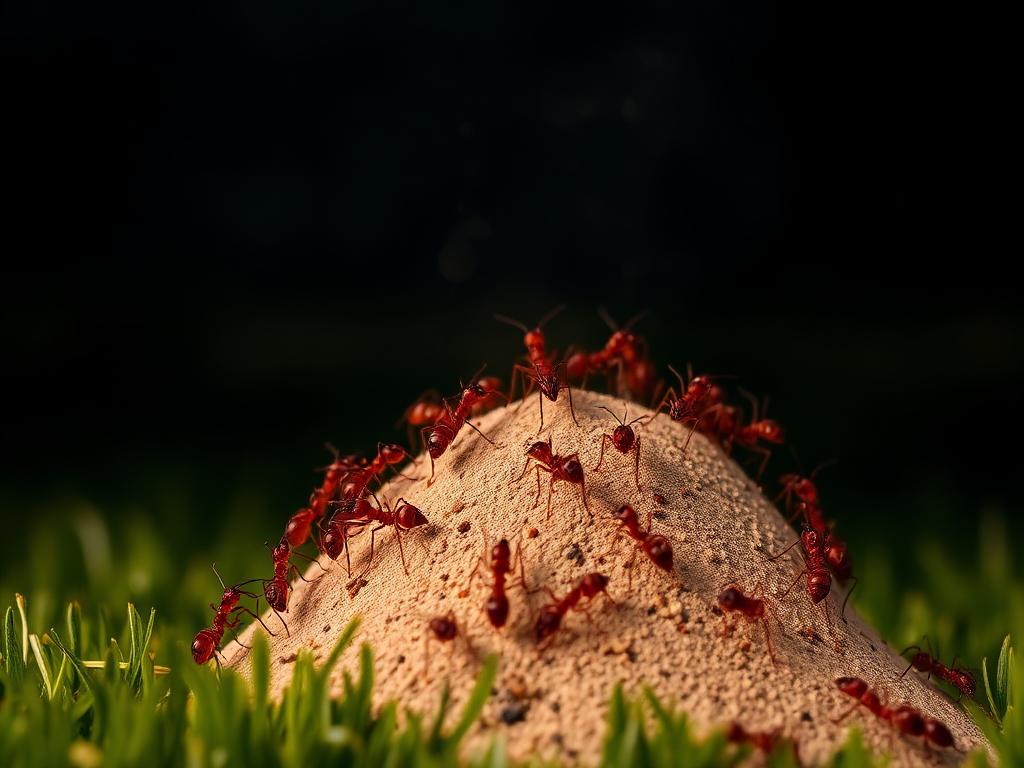
- Adult size
- 1/16" – 1/4", mixed sizes
- Color
- Reddish-brown with darker abdomen
- Group size
- 100,000 – 500,000
- Lifespan
- Queen up to 7 years
Identifying it
Reddish-brown ants of varying sizes in one colony, building dome-shaped mounds with no central opening. Swarm and sting aggressively when the mound is disturbed.
Why Portsmouth sees this
Their range has been expanding northward along the coastal plain, with established activity in southeastern Virginia and northeastern North Carolina.
Historic frame and masonry structures in Olde Towne and Park View, mid-century frame in Churchland and Cradock. Crawl spaces are the norm and many are shallow, tight, and originally unlined.
Low-lying land on the Elizabeth River with a water table near grade and legacy drainage. Historic-district repair standards limit how aggressively exteriors can be altered.
Red imported fire ants build the dome-shaped mounds without a visible central opening that homeowners occasionally find in a lawn, along a fence line, or in a field edge across the southern parts of Hampton Roads. Unlike most local ant species, fire ants respond to mound disturbance with a coordinated, aggressive defense, swarming up the nearest vertical object and delivering repeated stings that produce a distinctive white pustule within a day.
Fire ant mound-building activity in Hampton Roads is most visible in spring and fall, when soil temperatures are warm enough for active foraging and construction but not so hot that ants retreat deeper underground. During the height of summer heat, mounds are often less conspicuous at the surface because colonies shift activity deeper into the soil profile during the hottest parts of the day, foraging instead in early morning and evening. Heavy rain events can prompt mounds to rebuild rapidly afterward, sometimes appearing larger and more numerous than before a storm, as colonies respond to flooding by relocating and rebuilding. Winter slows activity significantly and mounds may appear dormant, but established colonies survive the region's relatively mild winters and resume full activity as temperatures warm the following spring.
When red imported fire ant activity peaks
Mound building explodes after spring rain; stings peak June through September.
June — activity index 95 / 100 (annual peak)
Does yours match? Interactive ID checklist
0 of 4 traits matched
Tick everything you can actually see.
Signs of red imported fire ant activity
- Dome-shaped soil mounds with no visible central opening, typically in sunny lawn or field areas.
- Aggressive swarming and repeated stinging when a mound is disturbed, even lightly, such as by a lawn mower.
- Small itchy welts that develop into distinctive white pustules within twenty-four hours of a sting.
- Multiple mounds appearing across a property within the same season, sometimes at increasing distance from the first.
- Mounds that appear to relocate a short distance after mowing or after heavy rain.
- Reddish-brown ants of noticeably varying sizes within a single mound when briefly disturbed.
Red Imported Fire Ant threat profile
Structural risk
10/100
Damage to framing, floors and finishes
Health risk
80/100
Bites, stings, allergens and pathogens
Spread rate
75/100
How fast it multiplies once established
DIY difficulty
80/100
How reliably store products fail on it
Field notes: red imported fire ant you did not know
- Fact 01
Colonies raft on floodwater — a living ball of ants that survives days afloat.
- Fact 02
The sting leaves a sterile white pustule that no other local ant produces.
- Fact 03
Quarantine lines have moved steadily north into southeastern Virginia.
How we remove it
Broadcast bait across the property followed by individual mound treatment, repeated seasonally to catch new colonies.
Routing City of Portsmouth daily, including Olde Towne, Park View, Churchland, Cradock, Port Norfolk, Westhaven.
The Guardex red imported fire ant treatment plan
01 · Property-wide mound survey
We survey the full property for active and satellite mounds rather than treating only the one that was reported, since new queens frequently establish additional colonies nearby within the same season.
02 · Broadcast bait application
A broadcast bait treatment across the affected turf area is applied first, since foraging workers carry the slow-acting bait back to the colony and queen, providing effective control across the whole property including mounds not yet visible.
03 · Individual mound treatment
Remaining active mounds are treated directly with a targeted product to eliminate the colony more quickly than broadcast bait alone, particularly for mounds close to high-traffic areas like walkways or play areas.
04 · Seasonal follow-up monitoring
Because new colonies can establish from mating flights throughout the season, we schedule a follow-up inspection to catch and treat new mounds before they mature, rather than treating once and assuming the problem is fully resolved.
Why store-bought products usually fail
Pouring boiling water or a retail insecticide directly onto a fire ant mound often kills only a fraction of the colony and can trigger the surviving portion to relocate a short distance rather than being eliminated, since the underground gallery network extends well beyond the visible dome. Homeowners frequently treat only the mound they can see while missing satellite colonies elsewhere on the property, allowing the population to persist and continue expanding. Broadcast bait products sold at retail can be effective in principle, but timing and application rate matter significantly for fire ants, and incorrect timing — applying during the heat of the day when foraging has shifted underground, for instance — can waste the application. Given the sting risk involved in even approaching an active mound to treat it, professional treatment also reduces the personal injury risk of a DIY approach gone wrong.
Prevention checklist
- Inspect open lawn areas periodically for new mounds, especially after rain and in spring and fall.
- Keep children and pets away from any unidentified mound until it has been treated or confirmed inactive.
- Avoid mowing directly over an active mound, since disturbance can trigger stinging and mound relocation.
- Treat new mounds promptly rather than waiting to see if the colony grows.
- Be cautious around field edges, pastures, and undeveloped lots in Suffolk, Chesapeake, and Isle of Wight County, where established populations are more likely.
- Schedule a broadcast property treatment in spring for properties with a history of fire ant activity, rather than waiting for new mounds to appear.
Red Imported Fire Ant questions we get asked
- Are red imported fire ants actually established in Hampton Roads?
- Yes, the species' range has expanded northward along the coastal plain and established activity is documented in southeastern Virginia, most commonly found in the more open, sunny lawns and field edges of Suffolk, Chesapeake, and Isle of Wight County.
- What should I do if I find a mound in my yard?
- Keep children and pets away from it and avoid disturbing it yourself, since even light disturbance can trigger a coordinated stinging response. Have it identified and treated rather than attempting to pour a home remedy on it.
- How long does it take to control a fire ant problem on a property?
- Broadcast bait typically shows results across the whole property within two to four weeks as colonies decline, while individually treated mounds can be eliminated faster; a follow-up visit is recommended later in the season to catch new colonies.
- Are fire ant stings dangerous?
- Most stings cause painful welts that develop into a characteristic white pustule, but a smaller number of people have more serious allergic reactions, including anaphylaxis, which is why prompt mound treatment matters for households with known allergy risk.
- Why do new mounds keep appearing after I treat one?
- Mature colonies can produce new queens that fly off and establish satellite colonies elsewhere on the same property, so a single mound is often not the only one; a full property survey and broadcast treatment address this better than spot-treating one mound.
Other pests in Portsmouth
- Eastern Subterranean Termite control in Portsmouth
- Formosan Subterranean Termite control in Portsmouth
- Powderpost Beetle control in Portsmouth
- Carpenter Ant control in Portsmouth
- Carpenter Bee control in Portsmouth
- Wood-Decay Fungus control in Portsmouth
- German Cockroach control in Portsmouth
- American Cockroach control in Portsmouth
- Oriental Cockroach control in Portsmouth
- Odorous House Ant control in Portsmouth
- Norway Rat control in Portsmouth
- House Mouse control in Portsmouth
- Squirrel control in Portsmouth
- Camel Cricket control in Portsmouth
- Springtail control in Portsmouth
- Asian Tiger Mosquito control in Portsmouth
- Salt Marsh Mosquito control in Portsmouth
- Blacklegged (Deer) Tick control in Portsmouth
- Yellowjacket control in Portsmouth
- Bed Bug control in Portsmouth
- Brown Marmorated Stink Bug control in Portsmouth
Red Imported Fire Ant nearby in South Hampton Roads
Red Imported Fire Ant problem in Portsmouth?
Tell us where you are finding them and how often. We will confirm the species and put a plan on the calendar.
Request an inspection